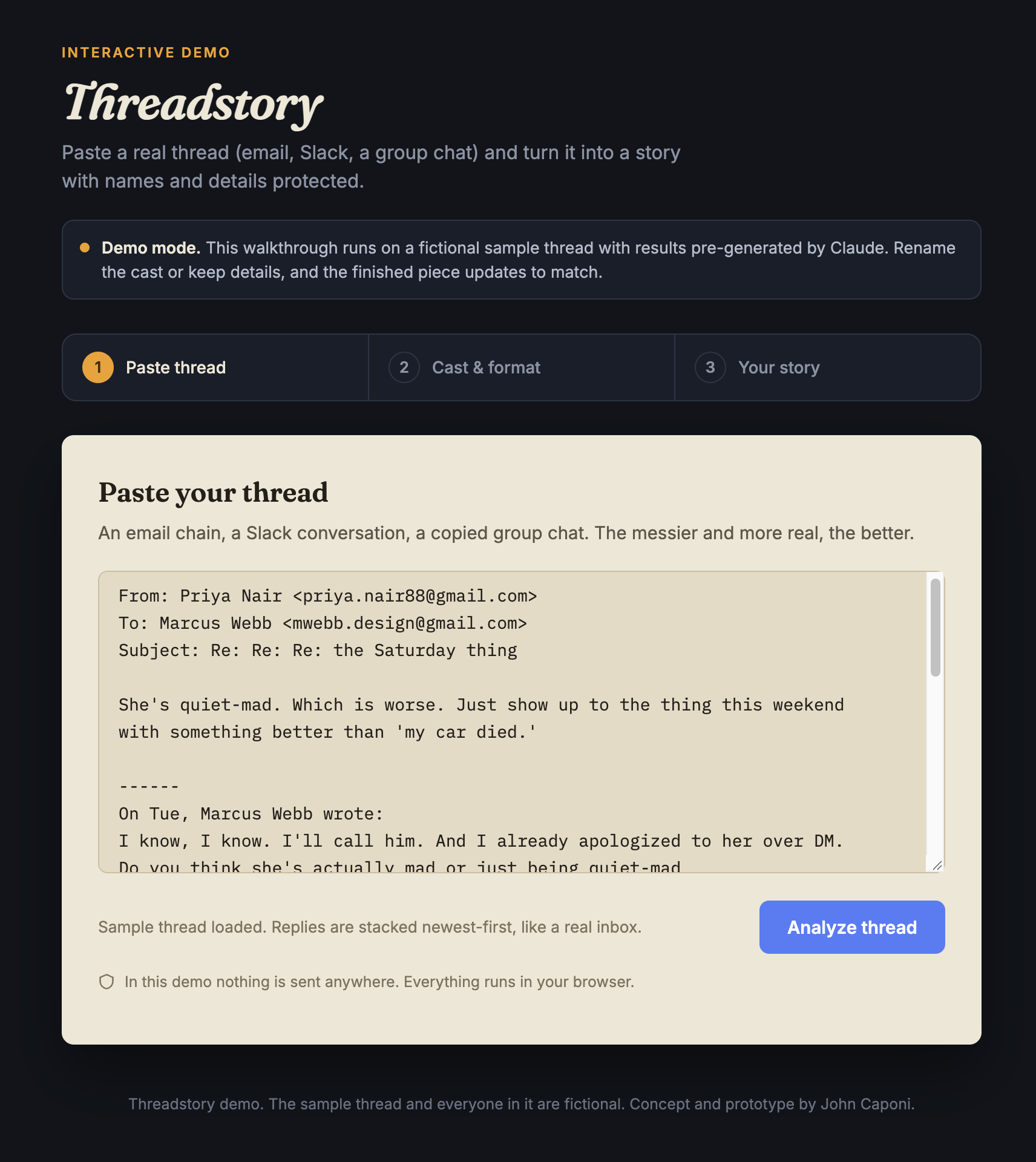
Threadstory
In March 2008, I brought an idea to one of my favorite writers and collaborators, Peter Chase: what if there were a written-word version of YouTube? It would be a place where people posted the email and chat threads they already had, the ones too good not to share, and others browsed them like short stories, sorted into categories, rated, and collected into a library. Peter and I brainstormed it together and built a pitch deck around it. The insight underneath was simple: real conversations, overheard in text form, are compelling reading.
The idea was early. Over the next eighteen years, the internet proved it out without us. Advice forums grew up around reader-submitted conflicts, social accounts were built entirely from screenshotted texts, and “story time” became its own genre. The appetite was real; it just scattered across a dozen platforms instead of landing on one site. And the hardest part of our original flow was the part no one had solved: hand-editing a thread to scrub names, numbers, and addresses before anyone could post it.
In 2026, I picked it back up, because that hard part had become something AI does well. I kept the original insight and the original three-step shape (edit, review, share) and rebuilt everything around it. Threadstory stopped being a destination site and became a tool that meets people where their threads already live. You paste in an email chain, a Slack conversation, or a group chat, and it returns a finished, shareable piece with every identity protected. The library, rankings, comments, and ad model were left behind deliberately, not forgotten.
I treated privacy as the foundation rather than a feature. The first AI pass reads the thread and proposes a “cast”: every person, phone number, email, and address it finds. Each one is paired with a pseudonym, so the same person carries the same alias everywhere they appear. The user reviews that cast, renames anyone, and decides what stays. Email chains, which stack replies newest-first, are put back into chronological order before anything gets written. At the end, a “What we changed” panel shows each redaction as a blacked-out bar you tap to reveal, so you can check the work before sharing it. Trust, here, was a design problem.
Then came the fun part. The same thread can become an anonymized transcript, a narrated short story, a screenplay, or a quick digest. The prose formats can also borrow a literary sensibility: gothic and obsessive in the spirit of Poe, quiet surrealism after Murakami, or spare and unresolved like Carver. The tool borrows their technique and mood, never their words. Each finished piece gets three dramatic title options to choose from. I designed and built the working prototype in collaboration with Claude, which was itself part of the point: the concept came first, and the tools finally caught up to it.
Alongside the build, I mapped where it could go. One path is a consumer subscription. Another is licensing the redaction engine to legal, healthcare, and research teams, who face the same problem of keeping one person consistent across a thousand messages. There’s also the honest question of whether a name built for storytelling belongs in a compliance meeting. It started as a website idea in 2008. Eighteen years later, it’s a working tool, and the idea underneath it never changed.
Try the interactive demo → threadstory-v1-demo.netlify.app
Credits
John Caponi / Concept, product design, and prototype / Threadstory (2008 and 2026)
Peter Chase / Writer and collaborator / Concept development and pitch deck (2008)